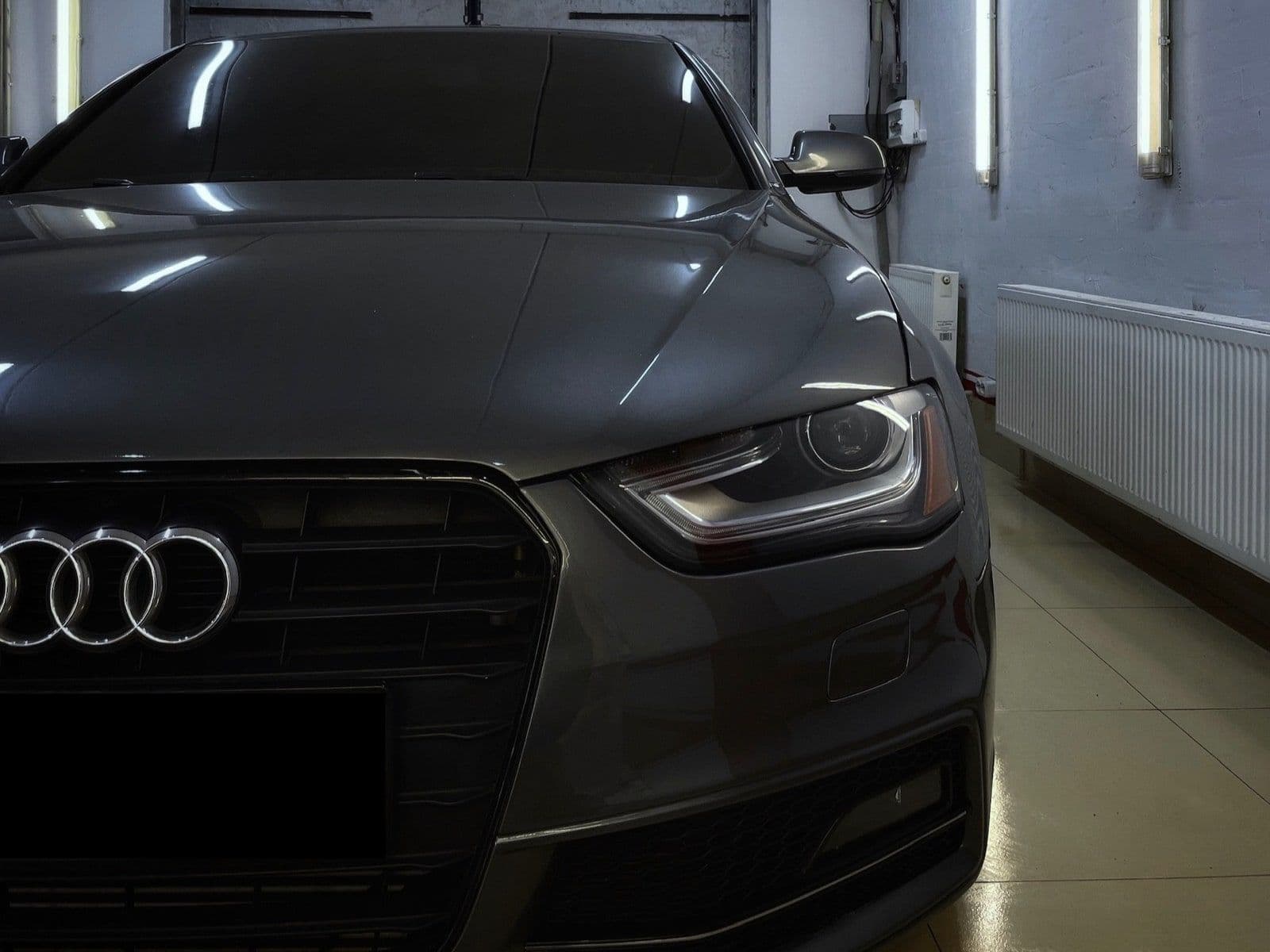
Paint polishing — your finish, restored.
Machine polishing with the Koch Chemie system. One-stage maintenance or two-stage paint correction removing swirl marks and oxidation — from dull to mirror-bright.
What's included
- Thorough wash and degreasing of the paintwork (pH-neutral)
- Clay bar treatment — removes iron, tree sap, tar and airborne contamination
- Paint thickness measurement with Elcometer 456 — documented before and after
- One-stage polishing: Koch Chemie H8.02 for maintenance and gloss
- Two-stage paint correction: H9.02 (correction) + H8.02 (refinement) — where needed
- Swirl marks, scratches and oxidation removed by machine
- Finishing protection with wax or synthetic sealant
- Ceramic coating Gardx Ceramic CX² available as an add-on
How it works — step by step
← Swipe through the steps →
Materials and equipment
What we need on-site
- Shaded area — direct sunlight makes polishing impossible
- Parking space approx. 3 × 6 m near the car
- Access to a 230 V power outlet within 15 metres
- Access to water (garden hose or tap) within 20 metres
- Car should not be exposed to moisture for the first 12–24 hours after sealing
3 000 NOK
4–8 hours
At your place
Written
Pricing — polishing and paint correction
| Service | Sedan | SUV | Van | Time |
|---|---|---|---|---|
| One-stage polish | from 3 000 NOK | from 3 500 NOK | from 4 000 NOK | 4 h |
| Two-stage correction | from 5 000 NOK | from 6 000 NOK | from 7 000 NOK | 7–8 h |
| + Ceramic coating | +2 500 NOK | +2 500 NOK | +3 000 NOK | +1 h |
Time: 4 h
Time: 7–8 h
Time: +1 h
Final price after paint assessment. Vipps · cash.
Recent jobs
Frequently asked questions about car polishing
One-stage polishing uses a single product combining mild correction with gloss enhancement — suited to cars with light wear and swirl marks. Two-stage uses a more aggressive compound first (correction), then a fine polishing step — suited to cars with visible scratches, oxidation or a dull finish.
Only if done incorrectly — wrong speed, wrong pad or polishing through the clear coat. That's why we measure paint thickness with an Elcometer 456 on every panel before we start and tailor the polishing intensity accordingly. You get to see the documentation.
Clay bar treatment is a mechanical cleaning step removing iron particles, tree sap, tar and other contamination bonded to the paint — which washing alone cannot remove. Does your paint feel slightly rough after a wash? That's contamination. Clay removes it and creates a clean base for polishing.
Overcast weather is actually ideal — even, diffuse light makes it easier to see swirl marks and assess the result. Direct sun is the problem: paint heats up, product dries too fast, and the result is uneven. We don't polish in direct sunlight.
The correction work itself — removing swirl marks — is permanent until the car accumulates new scratches. The sealant protection (wax or synthetic) lasts 4–12 months depending on product and exposure. Ceramic coating lasts 2–5 years.
Yes, and it's the ideal order: polishing corrects the paint, then we apply ceramic coating to a clean, swirl-free surface. We use Gardx Ceramic CX² — with proper care it protects the paint for 2–3 years.
- What's the difference between one-stage and two-stage polishing?
- One-stage polishing uses a single product combining mild correction with gloss enhancement — suited to cars with light wear and swirl marks. Two-stage uses a more aggressive compound first (correction), then a fine polishing step — suited to cars with visible scratches, oxidation or a dull finish.
- Can the paint be damaged during machine polishing?
- Only if done incorrectly — wrong speed, wrong pad or polishing through the clear coat. That's why we measure paint thickness with an Elcometer 456 on every panel before we start and tailor the polishing intensity accordingly. You get to see the documentation.
- What is clay bar treatment, and do I need it?
- Clay bar treatment is a mechanical cleaning step removing iron particles, tree sap, tar and other contamination bonded to the paint — which washing alone cannot remove. Does your paint feel slightly rough after a wash? That's contamination. Clay removes it and creates a clean base for polishing.
- Can I polish a car in dark or overcast weather?
- Overcast weather is actually ideal — even, diffuse light makes it easier to see swirl marks and assess the result. Direct sun is the problem: paint heats up, product dries too fast, and the result is uneven. We don't polish in direct sunlight.
- How long does polishing last?
- The correction work itself — removing swirl marks — is permanent until the car accumulates new scratches. The sealant protection (wax or synthetic) lasts 4–12 months depending on product and exposure. Ceramic coating lasts 2–5 years.
- Can I add ceramic coating after polishing?
- Yes, and it's the ideal order: polishing corrects the paint, then we apply ceramic coating to a clean, swirl-free surface. We use Gardx Ceramic CX² — with proper care it protects the paint for 2–3 years.
Ready for a mirror-bright finish?
Send a few daylight photos — we'll assess the paint condition and give you a fixed quote the same day.
Time agreed when you book · Vipps · cash